Exterior property treatments focus on interrupting vector life cycles in shaded, damp microclimates across Kent County yards. Properties bordering mature canopies in Creston and Fulton Heights or low-elevation drainage…
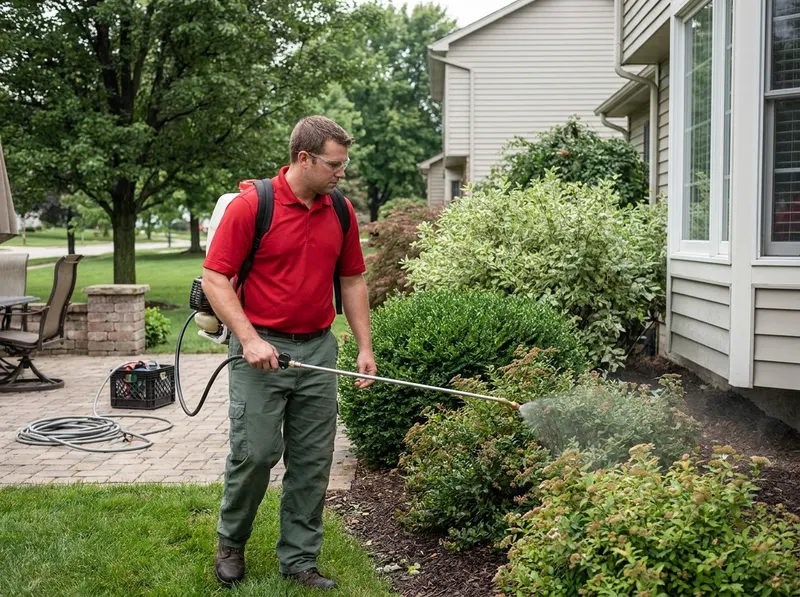
Exterior property treatments focus on interrupting vector life cycles in shaded, damp microclimates across Kent County yards. Properties bordering mature canopies in Creston and Fulton Heights or low-elevation drainage pathways near the Grand River corridor face constant emergence of Culex and Aedes mosquitoes between May and October. Unlike broad-acre aerial applications, targeted barrier applications deposit microscopic synthetic pyrethroids or botanically derived microencapsulated residuals onto the undersides of broadleaf shrubs, groundcovers, and perimeter fences where mosquitoes rest during daytime heat. This method protects beneficial mid-canopy pollinators by restricting droplet dispersion to lower resting zones beneath 8 feet.
Decision guidance depends on property foliage density and water retention. Single-treatment event applications suit outdoor gatherings near Fish Ladder Park or neighborhood events in East Hills, providing 14 to 21 days of adulticide suppression. In contrast, recurring 28-day rotational applications fit riverfront properties in Belknap Lookout or heavily shaded lots in Heritage Hill and Alger Heights, where high soil moisture and continuous organic leaf litter foster regular egg hatching. The operational trade-off of barrier treatments is persistence versus precipitation: rain exceeding 1.5 inches within 24 hours of treatment can dilute foliage residues, requiring supplemental perimeter touch-ups.
Foundation barrier defense pairs with vegetation misting to stop crawlspace and perimeter penetration. In older neighborhoods like Eastown and Garfield Park, stone or brick foundations frequently develop micro-fissures where spiders, crickets, and carpenter ants gather before finding sill-plate entryways. Technicians apply a uniform 3-foot upward band on exterior foundations and a 2-foot outward band across surrounding soil, gravel, or turf. This dual-zone setup reduces pest populations in the yard while stopping crawling insects from crossing the thermal envelope of the home.
Operational steps follow a structured diagnostic pattern:
1. The technician maps standing water sources, dense vegetation pockets, and shaded structural zones around the residence.
2. Invertebrate breeding spots such as unmaintained birdbaths, clogged gutters, and drainage catch basins receive larvicide ring
Tell us about your mosquito and exterior property sprays job in Grand Rapids and we'll send a clear, written quote, usually the same day.
 Iverna Pest Pros